"For now we see only a reflection as in a mirror; then we shall see face to face. Now I know in part; then I shall know fully, even as I am fully known."
— 1 Corinthians 13:12 (NIV)
1 Corinthians 13:12 means that what we see now is real and indirect, and that a day is coming when we will see face to face and know fully. In the NIV, "For now we see only a reflection as in a mirror; then we shall see face to face. Now I know in part; then I shall know fully, even as I am fully known." The line people search, "through a glass darkly," is the King James wording of the same sentence: "For now we see through a glass, darkly; but then face to face." What "through a glass darkly" means is that clause. The sight is a true sight. It is not yet the face.
Paul is finishing an argument, not offering a mood about how confusing life feels. Partial prophecy and partial knowledge belong to the time of the mirror. Face-to-face sight belongs to what comes after that time. The verse is eschatology inside the love chapter: now, and then.
1 Corinthians 13 is the whole chapter. What 1 Corinthians 13:4-7 means stays with patient, kind love. 1 Corinthians 13:7 stays with "love bears all things." 1 Corinthians 13:8 stays with "love never fails" and why prophecies, tongues, and knowledge pass away. 1 Corinthians 13:11 stays with "when I was a child" and putting away the ways of childhood. The greatest of these is love stays with verse 13. Love and heaven is the wider hope of life with God. The verse people look up as through a glass darkly is Through a glass darkly. This page stays with verse 12.
Free PDF
Get the free 30 Days of Love Verses PDF
Sign up for the daily Bible verse email, and get the free 30 Days of Love Verses PDF. 30 Days of Love Verses · Open the PDF
What "through a glass, darkly" means
The wording in the block above is the NIV. The ESV says, "For now we see in a mirror dimly, but then face to face. Now I know in part; then I shall know fully, even as I have been fully known." The KJV says, "For now we see through a glass, darkly." All three are the same Greek sentence.
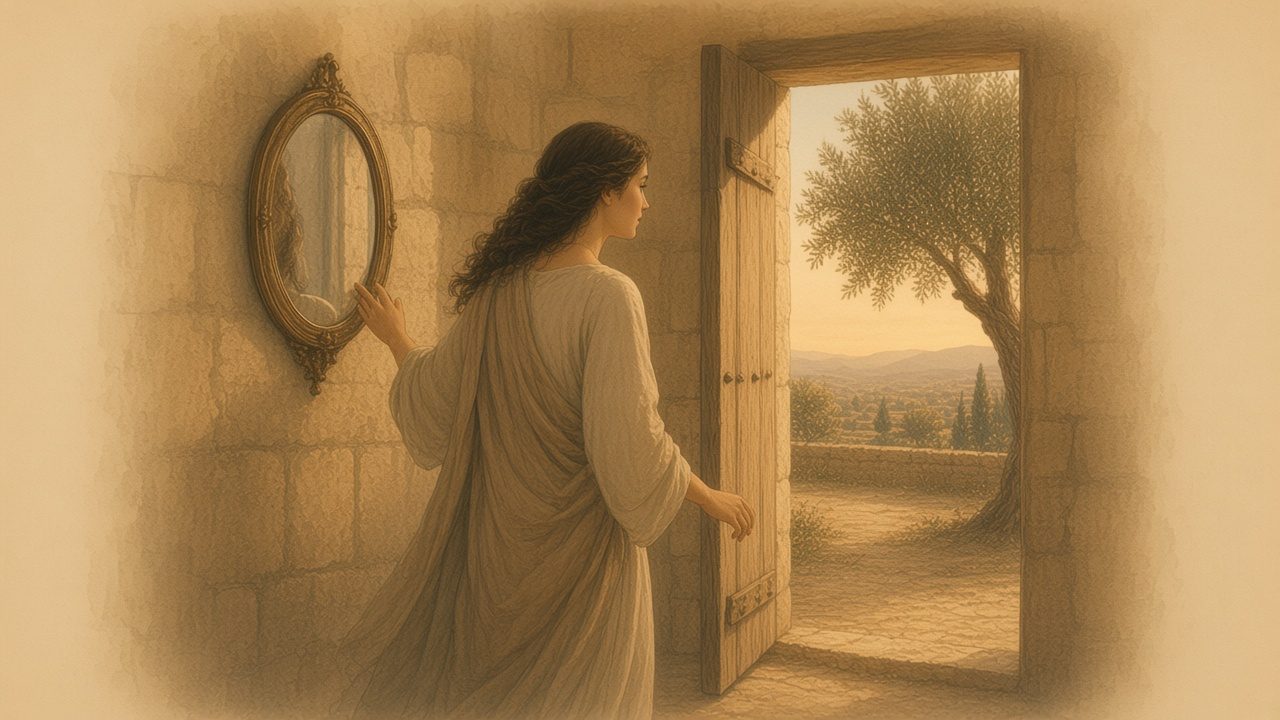
"Glass" in the KJV is a looking-glass, not a window. The Greek is di' esoptrou: "through a mirror." An esoptron was a polished metal mirror, usually bronze. It showed a real face. It did not show the person standing in the room the way open sight does. "Through a glass" is that older English for a mirror. It is not a pane of dirty window glass you squint through.
"Darkly" translates en ainigmati: "in a riddle," or "in an enigma." The ESV's "dimly" and the NIV's "only a reflection" are trying to say the same thing in plainer English. The image is indirect. You are looking at something true, and you are looking at it the way a riddle points at what it means. The face is really there. You do not yet have the plain sight.
That pair, riddle and face to face, is already in Scripture. When Miriam and Aaron challenge Moses, the Lord says he speaks to a prophet "in riddles," and then says of Moses, "With him I speak face to face, clearly and not in riddles" (Numbers 12:6-8, NIV). Paul uses both halves. The church's "now" is the riddle and the mirror. The church's "then" is the clear speech, face to face.
Now and then
The verse turns on two words: arti, "now," and tote, "then." Now we see by means of a mirror, in a riddle. Then, face to face. Now I know in part. Then I shall know fully, as I have been fully known.
"Then" is not a better technique and not a later century of study. It is the arrival the previous verses have already named. "For we know in part and we prophesy in part, but when completeness comes, what is in part disappears" (1 Corinthians 13:9-10, NIV). Verse 12 begins with "for." It gives the reason the partial disappears: seeing changes. The mirror is how we see while what we have is still in part. Face to face is what sight is when completeness comes.
Verse 11 is the picture just before this one: childish speech put away when a person grows up. What "when I was a child, I spoke as a child" and "put away childish things" mean is 1 Corinthians 13:11. Why prophecy, tongues, and partial knowledge pass away belongs to 1 Corinthians 13:8. This page is the change those gifts are waiting on. They serve indirect seeing. They are not the seeing itself.
"Face to face" is prosōpon pros prosōpon: presence to presence, without the mirror in between. In Numbers 12 it is how God speaks when he is not using a riddle. Paul aims the same words at the day when the church's partial knowledge is retired. The person is there. The reflection is no longer the way you meet him.
1 Corinthians 13:13 is the next sentence. Faith and hope are aimed at what we do not yet see, and love is what face-to-face sight does not retire. That ranking stays on the verse 13 page. Verse 12 is the sight those three are living toward.
Knowing in part, then knowing fully
The second half of the verse is about knowledge, and it matches the first half. "Now I know in part" is arti ginōskō ek merous. "In part" is the same phrase as verse 9, ek merous. The knowledge we have now is real, and it is partial, in the same way the mirror-sight is real and indirect.
"Then I shall know fully, even as I am fully known" is tote de epignōsomai kathōs kai epegnōsthēn. Epignōsomai is a stronger knowing than the bare "I know" of the first clause: to know clearly, to recognize. The NIV and the ESV both say "know fully." The comparison is kathōs kai, "just as also." The standard is not a library and not a list of secrets. The standard is the way I have already been known.
The last verb is passive. Epegnōsthēn: "I was known," "I have been fully known." God's knowledge of his people is not the thing waiting on the future. We are already fully known. The future is our knowing being brought up to a knowledge that is already fixed on us. Face to face and "as I am known" are the same hope from two sides. We will see without the mirror, and we will know with a clarity that matches the clarity with which we are already known.
That is personal knowledge. It is the knowledge of a person who has been seen, not a claim that every question about every subject will be handed over like a catalog. The verse says "as I am known," not "as every fact is stored." The one who knows us face to face is the one we will know in that same way.
John points at the same day from the other side of the New Testament: "when Christ appears, we shall be like him, for we shall see him as he is" (1 John 3:2, NIV). Seeing him as he is, and knowing as we are known, are one hope. Love and heaven stays with the home that hope is aimed at. This verse stays with the mirror and the face.
What the verse does not mean
A few limits keep "through a glass, darkly" from being used as a slogan it is not.
- It is not a proverb about life feeling confusing. Paul is talking about how the church knows God and God's future while completeness has not yet come. A hard week, a confusing decision, or a season of grief can be real without being this verse. The mirror is the present age of partial sight, set next to the day of face-to-face sight.
- "Darkly" is not moral darkness, and it is not God hiding in anger. En ainigmati means "in a riddle." The mirror still shows a face. The sentence is not about depression, and it is not about the Lord turning away. The next clause is "then face to face." The direction of the verse is toward presence.
- It does not say we know nothing of God now. The mirror reflects a real face, and "I know in part" is still knowing. Elsewhere Paul says that with unveiled faces we contemplate the Lord's glory and are being transformed (2 Corinthians 3:18). That is a real beholding in the present. 1 Corinthians 13:12 says that beholding is still a mirror. It is not yet face to face.
- It does not say Scripture is a riddle you cannot read. The riddle is our present grasp of what is still to come, not a claim that this chapter cannot be understood. Paul has just spent verses 4-7 speaking plainly about love. The mirror explains why prophecy and partial knowledge end. It does not take back the sentences he has already written.
- It is not verse 8, and it is not verse 13. Why love never fails, and why the gifts pass away, is 1 Corinthians 13:8. Why love is the greatest of faith, hope, and love is 1 Corinthians 13:13. Verse 12 is the sight in the middle: now a mirror, then a face, and knowledge brought up to the way we are already known.
Read the two halves together before you turn the phrase into a poster. Now: a mirror, in a riddle, knowing in part. Then: face to face, knowing as we are known.
Questions people ask
What does 1 Corinthians 13:12 mean?
It means that for now we see indirectly, as in a mirror, and that then we will see face to face and know fully, as we are already fully known. Paul is explaining why partial knowledge and partial prophecy give way when completeness comes. The sight we have now is real. It is not yet direct.
What does "through a glass darkly" mean?
It means we now see through a mirror, in a riddle. "Glass" in the King James Version is a looking-glass, and the Greek is esoptron, a mirror. "Darkly" translates en ainigmati, "in a riddle" or "dimly," not "in the dark." The phrase is the present half of 1 Corinthians 13:12. The other half is "but then face to face."
Why do some Bibles say "in a mirror dimly" instead of "through a glass darkly"?
They are translating the same clause, di' esoptrou en ainigmati. The KJV says "through a glass, darkly," using "glass" the way older English used it for a mirror. The ESV says "in a mirror dimly." The NIV says "only a reflection as in a mirror." The mirror is a real reflection. The riddle, or the dimness, is that the reflection is not yet face-to-face sight.
What does "then I shall know fully, even as I am fully known" mean?
It means our partial knowledge will become a clear, personal knowing, matched to the way God already knows us. The verb "I shall know" is epignōsomai, a recognizing that is fuller than "I know in part." "I am fully known" is passive: we have already been known. The future is not God discovering us. It is our sight and our knowledge being brought up to his.
How is 1 Corinthians 13:12 different from verses 8 and 13?
Verse 8 says love never fails, while prophecies, tongues, and knowledge pass away. Verse 12 says why the partial gives way: now we see in a mirror, then face to face. Verse 13 says faith, hope, and love remain, and that the greatest of these is love. 1 Corinthians 13:8 stays with the gifts that end. 1 Corinthians 13:13 stays with which of the three is greatest. This page stays with the mirror and the face.