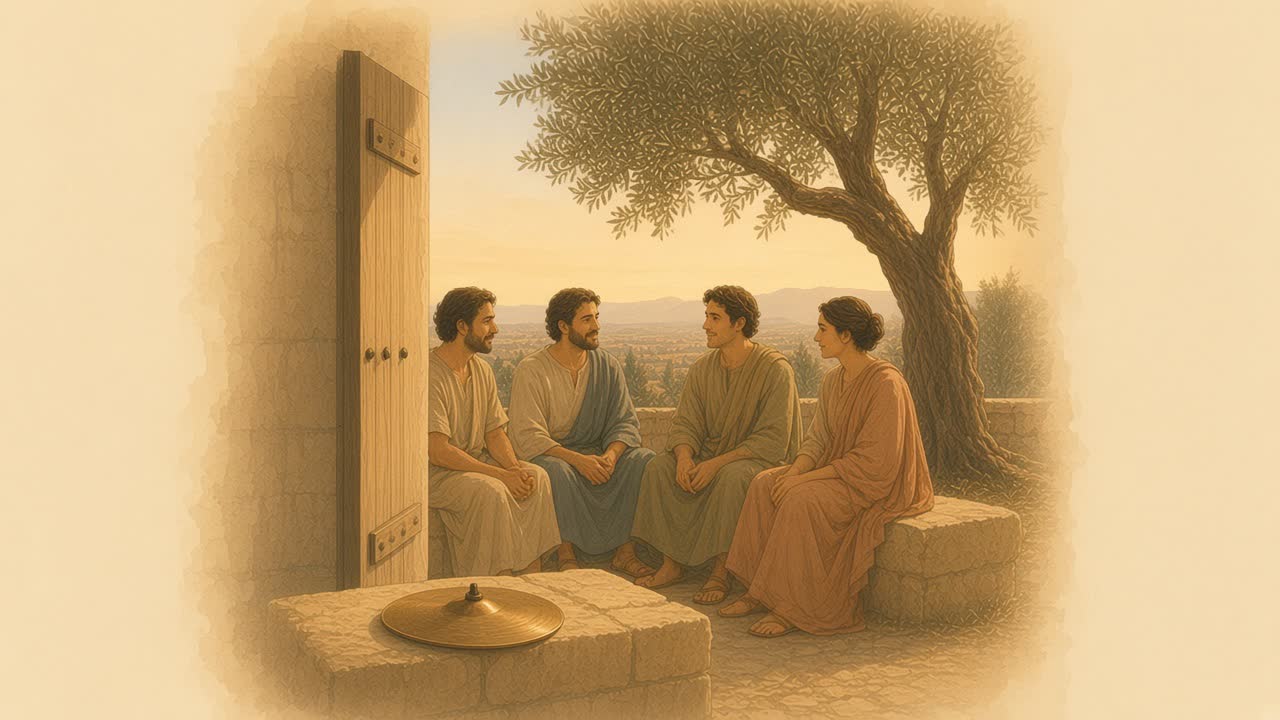
"If I speak in the tongues of men or of angels, but do not have love, I am only a resounding gong or a clanging cymbal."
— 1 Corinthians 13:1 (NIV)
1 Corinthians 13:1 means that speech, even the most impressive speech, is empty noise when love is missing. In the NIV, "If I speak in the tongues of men or of angels, but do not have love, I am only a resounding gong or a clanging cymbal." The King James Version says the same sentence in older English: "Though I speak with the tongues of men and of angels, and have not charity, I am become as sounding brass, or a tinkling cymbal." The lines people search, "clanging cymbal" and "sounding brass, or a tinkling cymbal," are those two wordings of one Greek picture. Paul is not forbidding tongues. He is saying tongues without love do not become a message. They become a noise.
Paul is opening the chapter he promised at the end of the gifts discussion. "Now eagerly desire the greater gifts. And yet I will show you the most excellent way" (1 Corinthians 12:31, NIV). Chapter 13 is that way. Chapters 12 and 14 are about spiritual gifts in the church at Corinth, and tongues are the gift that church was using to rank people. Verse 1 starts there. Verses 2 and 3 widen the same test to prophecy, knowledge, mountain-moving faith, and giving everything away. Verses 4-7 will then say what the missing love actually does.
1 Corinthians 13 is the whole chapter. What 1 Corinthians 13:4-7 means stays with patient, kind love. 1 Corinthians 13:8 stays with "love never fails" and why the gifts pass away. 1 Corinthians 13:11 stays with "when I was a child" and putting away the ways of childhood. The greatest of these is love stays with verse 13. This page stays with verse 1, and with the two verses that finish the same opening test.
Free PDF
Get the free 30 Days of Love Verses PDF
Sign up for the daily Bible verse email, and get the free 30 Days of Love Verses PDF. 30 Days of Love Verses · Open the PDF
What "a resounding gong or a clanging cymbal" means
The wording in the block above is the NIV. The ESV says, "If I speak in the tongues of men and of angels, but have not love, I am a noisy gong or a clanging cymbal." The KJV says, "Though I speak with the tongues of men and of angels, and have not charity, I am become as sounding brass, or a tinkling cymbal." "Charity" in the KJV is agapē, the same word the NIV translates "love." All three are one Greek sentence.
The Greek is gegona chalkos ēchōn ē kymbalon alalazon: "I have become echoing bronze, or a clanging cymbal." Gegona is the perfect of "become." The result stands. Without love, this is what the speaker has become.
Chalkos is bronze or brass, the metal, not the name of one instrument. Ēchōn means echoing, ringing, making a sound that carries. The KJV's "sounding brass" stays close to that: brass that sounds. The NIV's "resounding gong" and the ESV's "noisy gong" hear the same metal as an instrument that booms. Corinth was known for its bronze. Paul does not point to one bowl in the city. He names the noise bronze makes when it is struck and nothing else is being said.
Kymbalon is a cymbal. Alalazon is from alalazō, a loud cry, the shout used in battle or in worship that is mostly volume. The NIV's "clanging" catches that volume. The KJV's "tinkling" is milder English for the same participle. What "clanging cymbal" means is not a small, pretty chime. It is a cymbal that crashes. You hear it. It does not say anything.
A gong and a cymbal are real instruments. They belong in a procession. The point is not that sound is evil. The point is that this sound has no sentence in it. Speech in the tongues of men or of angels, if love is absent, has the same shape: loud, public, and empty of the person the words were for.
Tongues of men and of angels
"Tongues" translates glōssais. In this letter it is the gift the Corinthians were excited about, the same gift chapter 14 will regulate. A footnote in the NIV says the word can also be read "languages." Paul takes the claim at its highest. Not only the languages of human beings. The languages of angels. If the speech is that elevated, and love is missing, the result is still bronze and a cymbal.
He is writing to a church that treated this gift as proof of spirituality. Chapter 12 has already said the gifts come from one Spirit, for the common good, and that the body needs every member. Chapter 14 will say that tongues without interpretation do not build the church, because no one knows what is being said. Verse 1 is the moral center of that argument. The problem is not that someone spoke. The problem is speech used as a rank, with no love for the people in the room.
"I am only" in the NIV is a little softer than the Greek. Gegona is "I have become." The speaker does not merely sound like an instrument for a moment. Without love, that is what the gift has turned him into.
The love that is missing is the love verses 4-7 will define. It is patient and kind. It does not use a gift to stand over someone else. What 1 Corinthians 13:4-7 means stays with that portrait. This verse is the test that comes before the portrait: if the love is not there, the speech is noise.
What 1 Corinthians 13:1-3 means
Verse 1 is the first of three "if" sentences. The next two keep the same shape, so a search for "1 Corinthians 13:1-3" is this paragraph.
"If I have the gift of prophecy and can fathom all mysteries and all knowledge, and if I have a faith that can move mountains, but do not have love, I am nothing" (1 Corinthians 13:2, NIV). Prophecy, insight, and mountain-moving faith are the gifts people would set beside tongues. Paul does not shrink them. He grants them at full strength: all mysteries, all knowledge, faith that moves mountains. The conclusion is outhen eimi, "I am nothing." The person is not "less impressive." The person is nothing.
"If I give all I possess to the poor and give over my body to hardship that I may boast, but do not have love, I gain nothing" (1 Corinthians 13:3, NIV). The King James Version reads the last clause from a different Greek word: "though I give my body to be burned." One reading is handing the body over so that one may boast. The other is handing the body over to the flames. Either way, the cost is total, and the profit is ouden ōpheloumai, "I gain nothing." Sacrifice without love does not become love by being expensive.
Read the three together. Verse 1: speech without love is noise. Verse 2: gifts, knowledge, and faith without love leave a person nothing. Verse 3: giving everything away without love gains nothing. The chapter has not yet said what love does. It has said what everything else is when love is not there.
The gifts are not the enemy. 1 Corinthians 13:8 will say prophecies, tongues, and knowledge pass away, while love never fails. Verse 1 is earlier than that. It says those gifts can be real and still be empty of the one thing the church was called to want. 1 Corinthians 13:11 is later still: the partial gifts belong to a stage that completeness puts away. The most excellent way, the thing that is not noise and not nothing, is the love this chapter is about to describe, and the love verse 13 will call the greatest. That last sentence is 1 Corinthians 13:13.
Why Corinth is the setting
Chapters 12, 13, and 14 are one argument. Chapter 12 lists gifts and says the body of Christ is not a contest. The last sentence of that chapter offers the most excellent way. Chapter 13 is the way. Chapter 14 comes back to the meeting: prophecy that people can understand builds the church; tongues without an interpretation do not.
Verse 1 only makes sense inside that argument. "Tongues of men or of angels" is not a general remark about being hard to talk to. It is the gift Corinth was proud of, set next to love. A resounding gong in a meeting is already what uninterpreted speech is for the person who cannot understand it: sound without a message. Paul says the speaker without love has become that sound.
The whole chapter is in 1 Corinthians 13. This page stops at the opening test. It does not walk the patient-and-kind list, and it does not explain why the gifts cease.
What the verse does not mean
A few limits keep "clanging cymbal" from being used as a slogan it is not.
- It does not say spiritual gifts are worthless. Paul tells the same church to desire the greater gifts, and he thanks God that he speaks in tongues more than all of them (1 Corinthians 14:18, NIV). Verse 1 says a gift without love has become noise. It does not say the Spirit's gifts are noise. 1 Corinthians 13:8 says the gifts pass away. It does not say they were fake.
- It is not a ban on strong speech or on music. A cymbal in a procession is not the problem. The picture is speech that has volume and no love. Quiet cruelty is not excused because it does not clang.
- "Tongues of angels" is not a map of angelic language. Paul is granting the highest version of the claim. If the speech were angelic, love would still be the test. The verse does not describe what angels speak, and it does not tell a church how to verify a private prayer language. Chapter 14 is where he tells them what to do with the gift in the meeting.
- It is not verses 4-7, and it is not verse 13. What love is, once the noise has been named, is 1 Corinthians 13:4-7. Why love is the greatest of what remains is 1 Corinthians 13:13. Verse 1 is the first sentence of the argument: without love, the gift the church was ranking is a resounding gong or a clanging cymbal. The picture of partial gifts put away when completeness comes is 1 Corinthians 13:11.
Read the verse once as a test of a gift, and once as a test of a person. The gift can be speech of the highest kind. The person, without love, has become the instrument.
Questions people ask
What does 1 Corinthians 13:1 mean?
It means that if someone speaks in the tongues of men or of angels and does not have love, that person has become a resounding gong or a clanging cymbal. The King James Version says "sounding brass, or a tinkling cymbal." Paul is opening the love chapter for a church that ranked people by spiritual gifts. Impressive speech without love is noise. It is not a message, and it is not love.
What does "clanging cymbal" mean?
It means a cymbal that crashes, loud and without words. The Greek is kymbalon alalazon. Alalazon is a loud cry, the kind of shout that is mostly volume. The NIV says "clanging cymbal." The ESV says the same. The KJV says "tinkling cymbal," which is milder English for the same line. In the verse, that cymbal is what speech becomes when love is missing.
What is a resounding gong, or sounding brass?
Both phrases translate chalkos ēchōn, bronze or brass that echoes. The KJV stays with the metal: "sounding brass." The NIV and the ESV hear that ringing metal as a gong: "resounding gong," "noisy gong." Corinth was known for bronze. Paul does not point at one object in the city. He points at the noise. Struck metal carries. It does not speak. Speech without love has become that noise.
What does 1 Corinthians 13:1-3 mean?
It means that gifts, knowledge, and sacrifice are nothing without love. Verse 1 says tongues without love are a clanging cymbal. Verse 2 says prophecy, all knowledge, and faith that moves mountains, without love, leave a person nothing. Verse 3 says giving everything to the poor, and giving up one's body, without love, gains nothing. The three sentences are one test. What love itself is comes next, in verses 4-7.
Why does Paul mention tongues here?
Because the church in Corinth was dividing over spiritual gifts, and tongues were the gift they prized. Chapters 12 and 14 are about the Spirit's gifts and about how tongues and prophecy work in the meeting. Chapter 13 stands between them as "the most excellent way" (1 Corinthians 12:31, NIV). Verse 1 starts with that gift. The point is not to end it. The point is that love is what makes any gift more than noise.