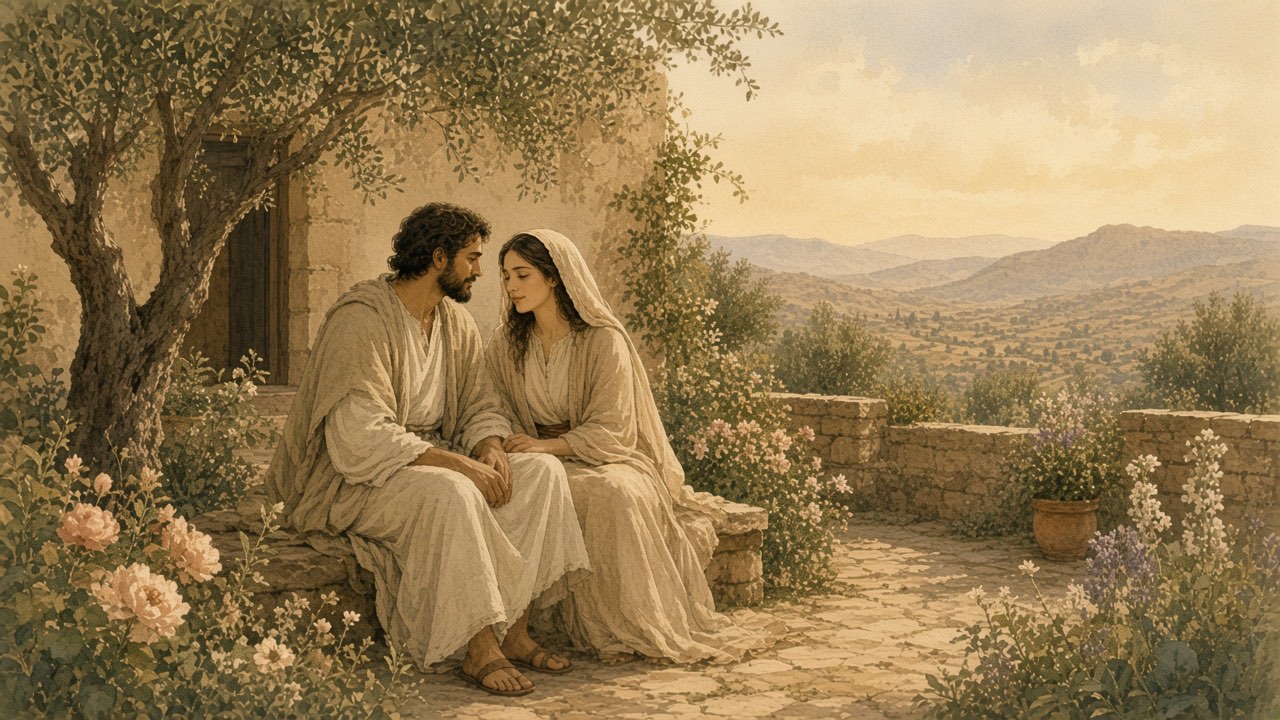

"Husbands, love your wives, just as Christ loved the church and gave himself up for her."
— Ephesians 5:25 (NIV)
Free PDF
Get the free 30 Days of Love Verses PDF
Sign up for the daily Bible verse email, and get the free 30 Days of Love Verses PDF. 30 Days of Love Verses · Open the PDF
The Biblical Perspective
Biblical marriage stands as one of the most sacred institutions designed by God, reflecting the very nature of His love for humanity. From the first chapters of Genesis to the closing pages of Revelation, Scripture consistently portrays marriage as a covenant love relationship—not merely a legal contract, but a profound spiritual union between husband and wife. In an age when marriages often falter under the weight of unmet expectations, God's Word offers timeless guidance for building Christian marriage relationships that endure. What Scripture asks of husbands is set out in Bible verses about husbands.
The foundation of a godly marriage is sacrificial love—the kind of selfless devotion modeled by Christ Himself. Ephesians 5 presents this staggering vision: husbands are called to love their wives with the same intensity and self-giving that Jesus demonstrated when He laid down His life for the church. This radical standard transforms marriage from a mere arrangement of convenience into a daily opportunity to image the gospel to a watching world.
Key Scriptural Insights
1. Marriage as God's Design: Genesis Foundation
The institution of marriage predates sin, government, and even organized religion. In Genesis 2:18, God declared, "It is not good for the man to be alone. I will make a helper suitable for him." This statement reveals that marriage was born from God's heart to meet humanity's need for deep, complementary companionship.
After creating Eve, God brought her to Adam, who responded with the first love poem in human history: "This is now bone of my bones and flesh of my flesh" (Genesis 2:23). The passage concludes with the foundational principle: "That is why a man leaves his father and mother and is united to his wife, and they become one flesh" (Genesis 2:24).
This "one flesh" union carries profound implications:
- Exclusivity: Marriage involves leaving other primary attachments to form a new primary bond
- Permanence: The two become one—a union not easily divided
- Intimacy: Physical, emotional, and spiritual closeness characterizes this relationship
- Partnership: The husband and wife work together as complementary allies
Jesus Himself affirmed this creation design when He quoted Genesis 2:24 and added, "So they are no longer two, but one flesh. Therefore what God has joined together, let no one separate" (Matthew 19:6). Marriage is not merely a human invention—it is a divine institution with sacred purpose.
2. Ephesians 5: The Marriage Blueprint
Perhaps no passage provides clearer instruction for Christian marriage than Ephesians 5:22-33. Here Paul presents a revolutionary vision of mutual submission rooted in reverence for Christ.
For husbands, the command is unmistakably sacrificial: "Husbands, love your wives, just as Christ loved the church and gave himself up for her" (Ephesians 5:25). This is not passive affection but active, costly, initiating love. Christ didn't wait for the church to become lovable—He loved her while she was still in rebellion. Husbands are called to love their wives with this same unconditional commitment.
Paul continues: "In this same way, husbands ought to love their wives as their own bodies. He who loves his wife loves himself" (Ephesians 5:28). A husband's care for his wife should be as natural and instinctive as caring for his own physical needs. Her flourishing becomes his priority.
For wives, Paul writes: "Wives, submit yourselves to your own husbands as you do to the Lord" (Ephesians 5:22). This submission is not about inferiority—both husband and wife bear God's image equally. Rather, it describes a voluntary yielding that mirrors the church's response to Christ's loving leadership. When a husband loves sacrificially, a wife's respectful response creates a beautiful dance of mutual honor.
The passage culminates with a stunning revelation: "This is a profound mystery—but I am talking about Christ and the church" (Ephesians 5:32). Christian marriage is designed to be a living parable of the gospel—husband and wife displaying the love between Christ and His people.
3. Practical Wisdom: Proverbs and Song of Solomon
While Ephesians provides the theological framework, other Scriptures offer practical wisdom for daily married life.
Proverbs 31:10-31 celebrates the character of an excellent wife—a woman of strength, wisdom, industry, and compassion. But notice: her husband also receives commendation for entrusting his heart to her and praising her publicly (v. 11, 28-29). A healthy marriage involves mutual admiration and verbal appreciation.
Proverbs 5:18-19 encourages romantic delight within marriage: "May your fountain be blessed, and may you rejoice in the wife of your youth... may you ever be intoxicated with her love." Physical affection and romantic passion are not merely permitted in marriage—they are celebrated.
Song of Solomon provides an entire book dedicated to marital love, filled with poetic expressions of desire, admiration, and commitment. The beloved declares, "I am my beloved's and my beloved is mine" (Song of Solomon 6:3). This mutual belonging captures the exclusive devotion that marks covenant marriage. She asks for that belonging as a seal in Song of Solomon 8:6: set me as a seal upon your heart, for love is as strong as death.
Practical Application
Biblical principles become transformative when applied intentionally. Here are specific ways to cultivate a Christ-honoring marriage:
Prioritize your spouse above all other human relationships. Genesis 2:24 says a man "leaves" father and mother to "be united" to his wife. Your spouse must be your first human priority—before parents, children, friends, or career. Regularly evaluate whether your time, energy, and emotional investment reflect this priority.
Practice daily sacrificial love. Ask yourself each morning: "How can I serve my spouse today?" Look for opportunities to put their needs, preferences, and well-being ahead of your own. Small acts of service—making coffee, handling a dreaded task, offering an encouraging word—accumulate into a lifetime of demonstrated love. If you want to notice which gesture tends to land, the Bible love language quiz sets five patterns next to a verse.
Communicate with honesty and kindness. Ephesians 4:15 calls us to "speak the truth in love." In marriage, this means addressing issues directly but gently, listening to understand rather than to respond, and creating safety for vulnerability. Schedule regular times to talk about your relationship, not just logistics.
Maintain physical and emotional intimacy. First Corinthians 7:3-5 emphasizes the importance of regular physical intimacy in marriage. But emotional connection matters equally—sharing dreams, fears, and daily experiences builds the closeness that sustains a relationship through every season.
Forgive quickly and completely. Every marriage involves two imperfect people. Colossians 3:13 instructs: "Bear with each other and forgive one another if any of you has a grievance against someone. Forgive as the Lord forgave you." Holding grudges poisons a marriage; extending grace gives it room to flourish. The next verse puts love over that forgiveness: Colossians 3:14 meaning, put on love, which binds the other virtues together.
Seek God together. Pray with and for your spouse. Read Scripture together. Attend church as a couple. Ecclesiastes 4:12 promises, "A cord of three strands is not quickly broken." When Christ stands at the center of your marriage, you have an unshakeable foundation.
Get help when needed. If your marriage is struggling, don't wait until crisis to seek counsel. Proverbs 11:14 says, "Where there is no guidance, a people falls, but in an abundance of counselors there is safety" (ESV). Pastoral counseling, Christian marriage retreats, and wise mentors can provide invaluable support.
Conclusion
Biblical marriage is both a profound privilege and a serious calling. God designed this covenant relationship to reflect the love between Christ and the church—a love marked by sacrifice, commitment, exclusivity, and joy. When husbands love their wives as Christ loves the church, and when wives respond with respect and support, marriage becomes a powerful witness to the gospel.
If your marriage is thriving, thank God and remain intentional about nurturing this precious gift. If your marriage is struggling, take hope: the same God who designed marriage also offers the grace to restore and strengthen it. Whether you're newlywed or celebrating decades together, the principles of Scripture remain your surest guide.
May your marriage be a beacon of covenant love in a world desperate to see what faithful, sacrificial, Christ-centered love looks like.
The same covenant story begins before the vows. Love and romantic relationships looks at dating with biblical intention, and Song of Solomon on true love shows a desire that is fierce and faithful. A list of the verses that say what marriage is, is Bible verses about marriage. The direct answer is What does the Bible say about marriage. Readings chosen for the ceremony itself are Wedding Bible verses. Readings for an anniversary, once those years have been lived, are Anniversary Bible verses. The wider answer, God's love and love for a neighbor as well as this covenant, is What does the Bible say about love.
📚 Explore More
- What Does the Bible Say About Marriage?
- What Does the Bible Say About Love?
- Bible Verses About Marriage
- Anniversary Bible Verses
- Wedding Bible Verses
- Song of Solomon 8:6 Meaning: Set Me as a Seal Upon Your Heart
- Love and Friendship
- Love and Patience
- God is Love
- 1 Corinthians 13
- Colossians 3:14 Meaning: Put On Love