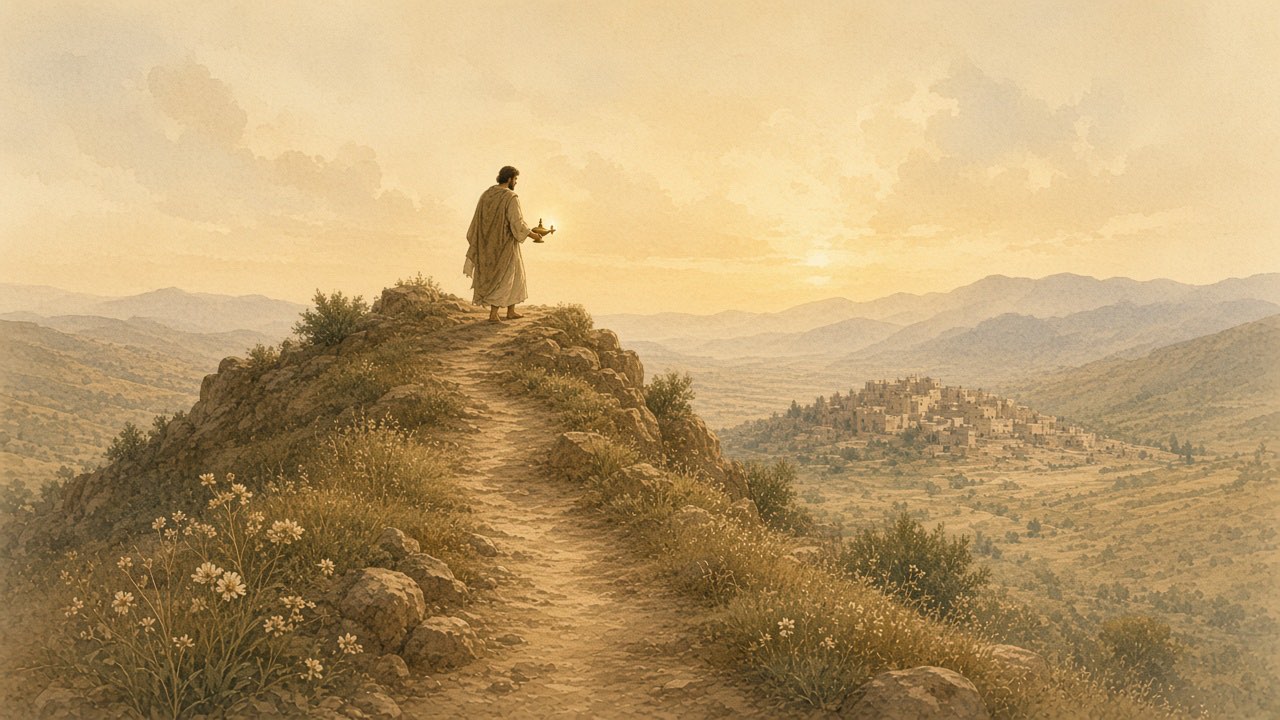
"And now these three remain: faith, hope and love. But the greatest of these is love."
— 1 Corinthians 13:13 (NIV)
Free PDF
Get the free 30 Days of Love Verses PDF
Sign up for the daily Bible verse email, and get the free 30 Days of Love Verses PDF. 30 Days of Love Verses · Open the PDF
8 Bible verses about faith, hope and love together
1 Corinthians 13:13 is the best-known verse that names faith, hope and love, and it has its own page: Faith, hope and love Bible verse. Paul and Peter put the same three words side by side in several other places. Hope fuels joy, and what the Bible says about joy traces that gladness.
- 1 Corinthians 13:13. "And now these three remain: faith, hope and love. But the greatest of these is love."
- 1 Thessalonians 1:3. "We remember before our God and Father your work produced by faith, your labor prompted by love, and your endurance inspired by hope in our Lord Jesus Christ."
- 1 Thessalonians 5:8. "But since we belong to the day, let us be sober, putting on faith and love as a breastplate, and the hope of salvation as a helmet."
- Colossians 1:4-5. "We have heard of your faith in Christ Jesus and of the love you have for all God's people—the faith and love that spring from the hope stored up for you in heaven."
- Romans 5:1-5. Justified "through faith," we "boast in the hope of the glory of God," and "hope does not put us to shame, because God's love has been poured out into our hearts through the Holy Spirit."
- Galatians 5:5-6. "For through the Spirit we eagerly await by faith the righteousness for which we hope... The only thing that counts is faith expressing itself through love."
- Hebrews 10:22-24. Draw near "with the full assurance that faith brings," "hold unswervingly to the hope we profess," and "spur one another on toward love and good deeds."
- 1 Peter 1:21-22. "Your faith and hope are in God. Now that you have purified yourselves by obeying the truth so that you have sincere love for each other, love one another deeply, from the heart."
For more Scripture on hope alone, see Bible verses about hope.
The Biblical Perspective
Why Paul calls love the greatest of the three is 1 Corinthians 13:13 Meaning: faith and hope are aimed at what we do not yet see, and love remains.
Biblical hope differs fundamentally from how our culture uses the word. When we say "I hope it doesn't rain," we express uncertain wishing. When Scripture speaks of hope, it describes confident expectation grounded in God's character and promises. Future promise is assured because the God who promises is faithful. Understanding God's plan for history and for our lives provides encouragement that sustains us through present difficulties. Hope, faith and love form an inseparable trio, each strengthening the others.
Christian hope doesn't deny present pain or pretend difficulties aren't real. Instead, it looks beyond present circumstances to certain future realities—the return of Christ, the resurrection of the dead, the new creation where pain and tears are no more. This hope isn't passive wishfulness but active confidence that changes how we live today. When the ache is an empty room, Bible verses about loneliness sit beside this hope.
Key Scriptural Insights
1. The Nature of Biblical Hope
Scripture defines hope with remarkable specificity:
Hebrews 6:19: "We have this hope as an anchor for the soul, firm and secure." Hope anchors us—it provides stability when life's storms threaten to sweep us away.
Romans 5:5: "And hope does not put us to shame, because God's love has been poured out into our hearts through the Holy Spirit." Biblical hope doesn't disappoint. It's grounded in God's love and Spirit, not in shifting circumstances.
1 Peter 1:3: "Praise be to the God and Father of our Lord Jesus Christ! In his great mercy he has given us new birth into a living hope through the resurrection of Jesus Christ from the dead." Christian hope is "living"—not dead letters on a page but dynamic reality rooted in the resurrected Christ.
Titus 2:13: We are "waiting for our blessed hope, the appearing of the glory of our great God and Savior Jesus Christ." Our ultimate hope is Christ's return.
Hope's characteristics:
- Certain: Based on God's faithfulness, not our circumstances
- Future-oriented: Looking beyond the present to what's coming
- Active: Shaping how we live now
- Anchoring: Providing stability in difficulty
2. Hope and Love Connected
Scripture weaves hope and love together:
1 Corinthians 13:7: "Love always protects, always trusts, always hopes, always perseveres." Hope is an essential component of love's character. What "always hopes" means in that verse is 1 Corinthians 13:7 Meaning.
1 Corinthians 13:13: "And now these three remain: faith, hope and love." The three stand together as permanent virtues outlasting everything else.
Colossians 1:4-5: "We have heard of your faith in Christ Jesus and of the love you have for all God's people—the faith and love that spring from the hope stored up for you in heaven." Notice the order: hope produces faith and love. When we're confident about the future, faith and love flow naturally.
Romans 15:13: "May the God of hope fill you with all joy and peace as you trust in him, so that you may overflow with hope by the power of the Holy Spirit." God Himself is called "the God of hope"—hope is central to His character and His gifts.
Why does hope enable love? Because when our future is secure, we're freed from selfish grasping. When we know God will provide, we can give generously. When we're certain of heaven, we can sacrifice on earth.
3. Hope in Suffering
Some of Scripture's richest hope passages address suffering:
Romans 5:3-5: "We also glory in our sufferings, because we know that suffering produces perseverance; perseverance, character; and character, hope. And hope does not put us to shame."
Romans 8:18: "I consider that our present sufferings are not worth comparing with the glory that will be revealed in us."
2 Corinthians 4:16-18: "Therefore we do not lose heart. Though outwardly we are wasting away, yet inwardly we are being renewed day by day. For our light and momentary troubles are achieving for us an eternal glory that far outweighs them all. So we fix our eyes not on what is seen, but on what is unseen, since what is seen is temporary, but what is unseen is eternal."
Lamentations 3:21-24: Even in profound grief, Jeremiah wrote, "Yet this I call to mind and therefore I have hope: Because of the LORD's great love we are not consumed, for his compassions never fail."
Hope doesn't eliminate suffering—it transforms it. Present pain becomes bearable in light of future glory.
Practical Application
How do we cultivate and live out hope?
Anchor your hope in specific promises. Vague hope wavers. Hope grounded in God's explicit promises—resurrection, return, new creation, His presence—stands firm. Know these promises; meditate on them.
Remember God's past faithfulness. Hope for the future grows from observing the past. How has God been faithful before? What has He brought you through? Let history build hope.
Limit despair's fuel. Constant negative input—news cycles, social media doom-scrolling, pessimistic voices—erodes hope. Be informed, but don't marinate in hopelessness.
Speak hope to others. Hebrews 10:23 says, "Let us hold unswervingly to the hope we profess." Then verse 24 continues: "Let us consider how we may spur one another on toward love and good deeds." Share hope with struggling brothers and sisters.
Let hope shape your priorities. If this life isn't all there is, how should that affect decisions about time, money, and energy? Living with eternity in view reorders priorities.
Hope actively, not passively. Biblical hope doesn't sit idle waiting. It works, serves, and loves—knowing that present labor has eternal significance.
Conclusion
In a world frequently marked by despair, Christians carry hope—not naive optimism that ignores reality but confident expectation grounded in a faithful God. This hope anchors our souls, fuels our love, and sustains our faith.
The story isn't over. Christ is coming. Resurrection awaits. A new creation is promised where "He will wipe every tear from their eyes. There will be no more death or mourning or crying or pain" (Revelation 21:4).
Fix your eyes on this hope. Let it shape how you live, love, and endure. For the one who promises is faithful.
Hope has to be specific when life caves in. Love and depression faces that darkness, and Romans 8:28 holds the promise that God works even painful things for good. The vocation that hope steadies is Bible verses about calling.
Questions people ask
What Bible verses talk about faith, hope and love?
1 Corinthians 13:13 is the best known: "And now these three remain: faith, hope and love." Paul names all three again in 1 Thessalonians 1:3, 1 Thessalonians 5:8, and Colossians 1:4-5, and Peter joins them in 1 Peter 1:21-22.
What is the difference between faith, hope and love?
Faith trusts God now. Hope waits for what he has promised and not yet given. Love acts toward God and other people. Paul calls love the greatest because it remains when faith becomes sight and hope is fulfilled (1 Corinthians 13:12-13).
What does the Bible say about hope and love?
Romans 5:5 ties them together: "hope does not put us to shame, because God's love has been poured out into our hearts through the Holy Spirit." And love "always hopes" (1 Corinthians 13:7).