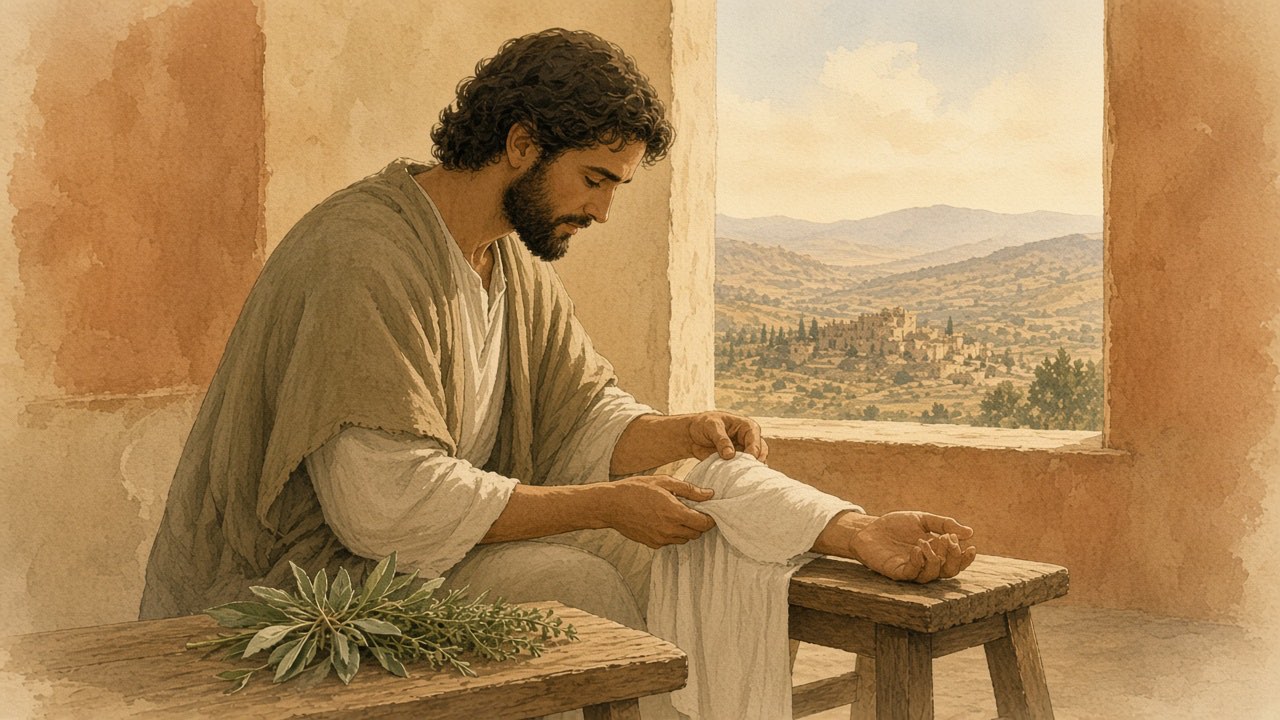
"Whoever dwells in the shelter of the Most High will rest in the shadow of the Almighty. I will say of the LORD, 'He is my refuge and my fortress, my God, in whom I trust.'"
— Psalm 91:1-2 (NIV)
Psalm 91 is the psalm many people pray for protection. This page gives its key verses, how Jesus met it in the wilderness, and a plain reading. For more verses on the theme, see Bible verses about protection, Bible verses about refuge, and Bible verses about trust. Verse 1 names the shelter of the Most High; see Bible verses about the Most High.
Free PDF
Get the free 30 Days of Love Verses PDF
Sign up for the daily Bible verse email, and get the free 30 Days of Love Verses PDF. 30 Days of Love Verses · Open the PDF
Key verses
The King James opens, "He that dwelleth in the secret place of the most High shall abide under the shadow of the Almighty. I will say of the LORD, He is my refuge and my fortress: my God; in him will I trust."
Other lines from the psalm (NIV):
- "He will cover you with his feathers, and under his wings you will find refuge; his faithfulness will be your shield and rampart." (verse 4)
- "You will not fear the terror of night, nor the arrow that flies by day." (verse 5)
- "For he will command his angels concerning you to guard you in all your ways; they will lift you up in their hands, so that you will not strike your foot against a stone." (verses 11-12)
- "'Because he loves me,' says the LORD, 'I will rescue him; I will protect him, for he acknowledges my name. He will call on me, and I will answer him; I will be with him in trouble, I will deliver him and honor him.'" (verses 14-15)
Key words
"Dwells" is yashab (H3427), to sit down or stay. "Shelter" (KJV "secret place") is sether (H5643), a hiding place or covering. "Shadow" is tsel (H6738), shade. "Almighty" is Shadday (H7706). "Refuge" is machaseh (H4268), a shelter from storm or danger, and "fortress" comes from matsud (H4686), a stronghold.
What the psalm is saying
The promises in Psalm 91 are made to the person who "dwells" with God, who stays close to him and says, "He is my refuge." Verse 4 uses the picture of a bird covering its young with its wings. The last three verses switch to God speaking in the first person: "I will rescue him... I will be with him in trouble."
Notice that the psalm says God will be with him in trouble, not that trouble never comes. Jesus showed how not to read it. In the wilderness the devil quoted verses 11-12 to tempt him to jump from the temple, and Jesus answered, "It is also written: 'Do not put the Lord your God to the test'" (Matthew 4:6-7). The psalm is about trusting God, not testing him. For more, see Bible verses about angels and Bible verses about God's faithfulness.
Questions people ask
What does Psalm 91 say?
It begins, "Whoever dwells in the shelter of the Most High will rest in the shadow of the Almighty" (NIV), or "He that dwelleth in the secret place of the most High shall abide under the shadow of the Almighty" (KJV). It ends with God's promise, "I will be with him in trouble, I will deliver him and honor him."
Who wrote Psalm 91?
The psalm has no title naming an author in the Bible.
Why is Psalm 91 called the protection psalm?
Almost every verse speaks of God guarding the one who trusts him: refuge, fortress, shield, wings, and angels. See Bible verses about protection.
What does "under his wings" mean in Psalm 91:4?
It pictures a mother bird covering her young. The verse says, "under his wings you will find refuge; his faithfulness will be your shield and rampart."
Where is Psalm 91 quoted in the New Testament?
The devil quoted Psalm 91:11-12 when tempting Jesus (Matthew 4:6; Luke 4:10-11). Jesus answered with Deuteronomy 6:16, "Do not put the Lord your God to the test."