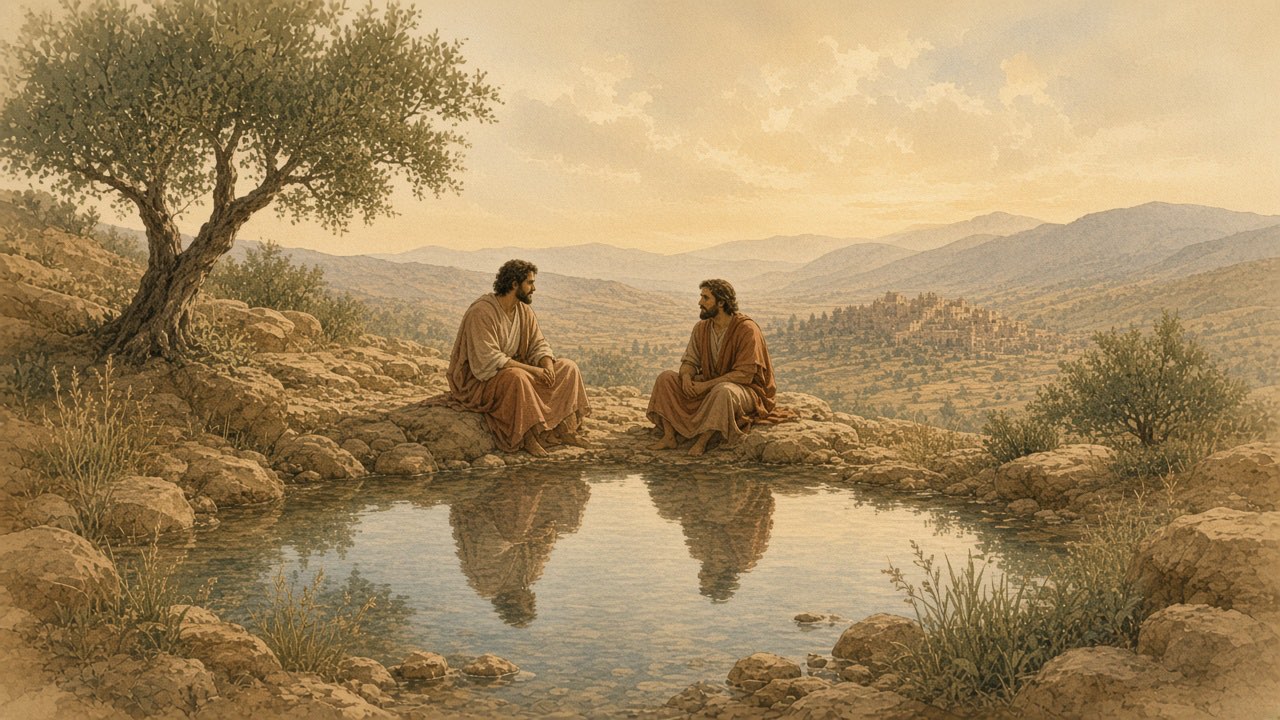

"For the Spirit God gave us does not make us timid, but gives us power, love and self-discipline."
— 2 Timothy 1:7 (NIV)
2 Timothy 1:7 is the verse many people know as "God has not given us a spirit of fear." This page gives the verse, the passage around it, and a plain reading. For more verses on the theme, see Bible verses about fear and Bible verses about courage. For the young pastor it was written to, see Bible verses about Timothy. The promise here is a spirit not of fear, and Bible verses about anxiety gathers the verses that meet an anxious heart with God's peace.
Free PDF
Get the free 30 Days of Love Verses PDF
Sign up for the daily Bible verse email, and get the free 30 Days of Love Verses PDF. 30 Days of Love Verses · Open the PDF
What do power, love, and a sound mind mean in 2 Timothy 1:7?
Paul wrote this letter to Timothy, the younger man he calls his dear son (2 Timothy 1:2). In the verse just before, he tells Timothy to fan into flame the gift of God (2 Timothy 1:6). Verse 7 then names what God gives instead of a spirit of fear: power, love, and a sound mind.
Power is strength to keep going and to stand with the gospel when that is costly. Love is care for God and for people, set between power and a sound mind so strength does not turn harsh. A sound mind is self-discipline: a steady, self-controlled mind, which is why the NIV says "self-discipline" and the KJV says "a sound mind." When you are afraid, the verse points you to those three gifts. You do not have to invent courage on your own.
The fear in view is timidity, not wise caution. The Greek word behind "fear" in the KJV, deilia, means cowardice or shrinking back. Romans 8:15 sets that kind of fear against the Spirit God gives his people. 1 John 4:18 says, "There is no fear in love. But perfect love drives out fear." The verse does not tell Timothy to ignore real danger. It says the spirit God gives is not a cowardly one, so he can use his gift and not be ashamed of the gospel (2 Timothy 1:8).
The verse
2 Timothy 1:7 (NIV) reads: "For the Spirit God gave us does not make us timid, but gives us power, love and self-discipline."
The King James says, "For God hath not given us the spirit of fear; but of power, and of love, and of a sound mind." The Greek word for "fear" (NIV "timid") is deilia (G1167), meaning timidity or cowardice. "Sound mind" (NIV "self-discipline") is sōphronismos (G4995), a steady, self-controlled mind.
2 Timothy 1:7 in other translations
People remember this verse in many wordings. Here it is in six common English translations.
- KJV: "For God hath not given us the spirit of fear; but of power, and of love, and of a sound mind."
- NKJV: "For God has not given us a spirit of fear, but of power and of love and of a sound mind."
- NIV: "For the Spirit God gave us does not make us timid, but gives us power, love and self-discipline."
- ESV: "for God gave us a spirit not of fear but of power and love and self-control."
- NLT: "For God has not given us a spirit of fear and timidity, but of power, love, and self-discipline."
- CSB: "For God has not given us a spirit of fear, but one of power, love, and sound judgment."
The words differ, but every version says the same three things: fear and timidity do not come from God, and what he gives is power, love, and a steady mind.
The passage around it
Paul wrote this letter "To Timothy, my dear son" (2 Timothy 1:2). He remembers Timothy's "sincere faith, which first lived in your grandmother Lois and in your mother Eunice" (2 Timothy 1:5).
Verse 6 sets up verse 7: "For this reason I remind you to fan into flame the gift of God, which is in you through the laying on of my hands." Verse 8 follows: "So do not be ashamed of the testimony about our Lord or of me his prisoner. Rather, join with me in suffering for the gospel, by the power of God." Paul was writing from chains (2 Timothy 1:16).
What the verse is saying
Paul is telling Timothy that fear and shyness do not come from God. What God gives is power to keep going, love for God and for people, and a clear, steady mind. That is why Timothy can stir up his gift and not be ashamed of the gospel.
Love sits in the middle of the list. The verse does not promise that hard things will not come; Paul was in prison when he wrote it. It says God equips his people to face them. For more on that, see Bible verses about God's power and Bible verses about self-control.
Questions people ask
What does 2 Timothy 1:7 say?
In the NIV it says, "For the Spirit God gave us does not make us timid, but gives us power, love and self-discipline." The KJV says, "For God hath not given us the spirit of fear; but of power, and of love, and of a sound mind."
Where in the Bible does it say God has not given us a spirit of fear?
It is 2 Timothy 1:7, in Paul's second letter to Timothy. The KJV and NKJV word it closest to how people quote it: "For God has not given us a spirit of fear, but of power and of love and of a sound mind" (NKJV). The ESV says "God gave us a spirit not of fear," and the NIV says the Spirit "does not make us timid."
Is "fear is not of the Lord" in the Bible?
Not in those words. The idea comes from 2 Timothy 1:7, which says the spirit of fear is not from God, and from 1 John 4:18, "There is no fear in love. But perfect love drives out fear." The Bible does speak well of "the fear of the LORD," meaning reverence for God, as in Proverbs 9:10: "The fear of the Lord is the beginning of wisdom."
What does a sound mind mean in 2 Timothy 1:7?
The Greek word sōphronismos means a disciplined, self-controlled mind. That is why the NIV translates it "self-discipline."
What is the context of 2 Timothy 1:7?
Paul, writing from prison, urges Timothy to "fan into flame the gift of God" (verse 6) and not to be ashamed of the gospel or of Paul (verse 8). Verse 7 gives the reason he can.
Who wrote 2 Timothy 1:7?
The letter opens, "Paul, an apostle of Christ Jesus by the will of God" (2 Timothy 1:1), and is addressed to Timothy. See Bible verses about Paul.
What verse goes well with 2 Timothy 1:7?
1 John 4:18 says, "perfect love drives out fear" (see Perfect love casts out fear). Isaiah 41:10 says, "So do not fear, for I am with you," and Joshua 1:9 says, "Be strong and courageous."
Who wrote 2 Timothy 1:7 and why?
The letter opens with "Paul, an apostle of Christ Jesus by the will of God" (2 Timothy 1:1) and is addressed "To Timothy, my dear son" (2 Timothy 1:2). Paul writes from prison (2 Timothy 1:16) to remind Timothy to fan into flame the gift of God (2 Timothy 1:6) and not to be ashamed of the testimony about the Lord or of Paul (2 Timothy 1:8). Verse 7 gives the reason Timothy can do that: God has given power, love, and a sound mind, not a spirit of fear.
Is fear a sin according to 2 Timothy 1:7?
2 Timothy 1:7 does not call every feeling of fear a sin. It says God has not given a spirit of fear, and the word there is timidity or cowardice (deilia), the shrinking back that would keep Timothy from his gift. The same chapter still says, "do not be ashamed of the testimony about our Lord" (2 Timothy 1:8). Scripture also speaks well of the fear of the Lord. Proverbs 9:10 says, "The fear of the Lord is the beginning of wisdom." 1 John 4:18 says, "There is no fear in love. But perfect love drives out fear," which belongs with the love named in this verse. What the verse states is that God gives power, love, and a sound mind, and that a cowardly spirit is not his gift.