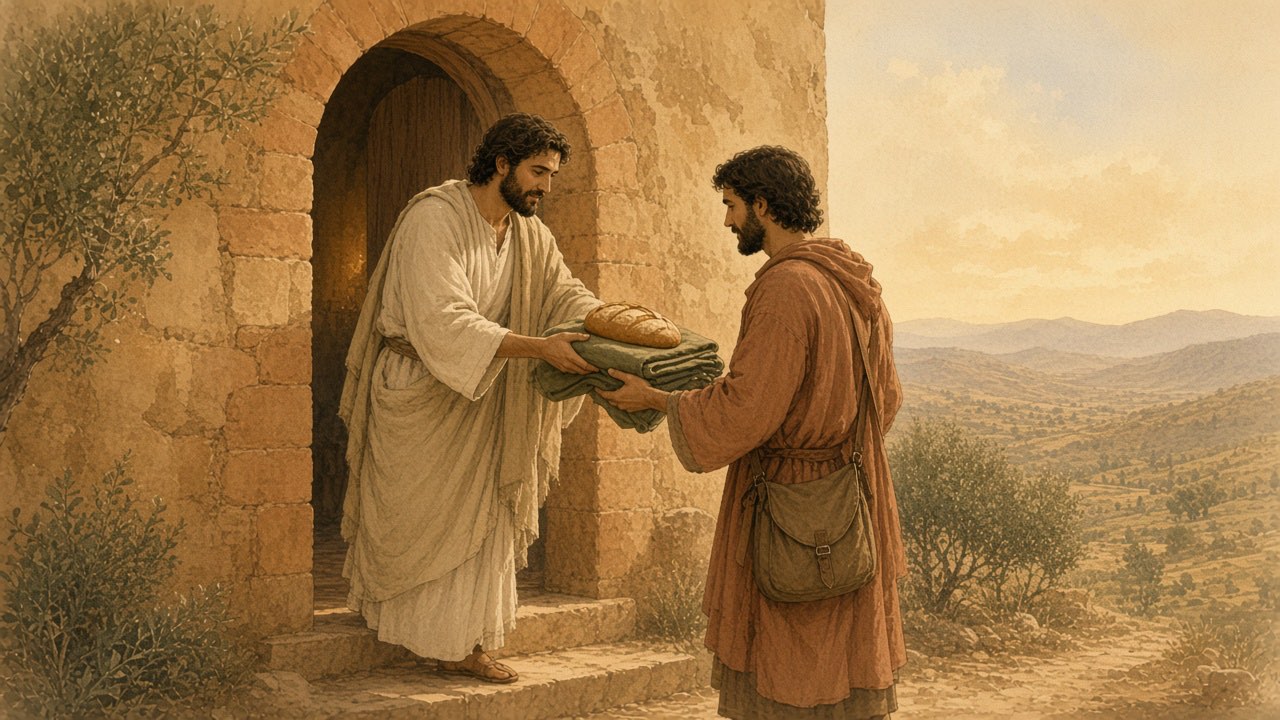

"The Lord himself goes before you and will be with you; he will never leave you nor forsake you. Do not be afraid; do not be discouraged."
— Deuteronomy 31:8 (NIV)
Deuteronomy 31:8 is the "the Lord himself goes before you" verse, spoken by Moses to Joshua just before Joshua takes over leading Israel. This page gives the verse, where it sits in Deuteronomy 31, and a plain reading. For more on the theme, see Bible verses about courage, Bible verses about fear, and Bible verses about loneliness.
Free PDF
Get the free 30 Days of Love Verses PDF
Sign up for the daily Bible verse email, and get the free 30 Days of Love Verses PDF. 30 Days of Love Verses · Open the PDF
The verse
The King James reads: "And the LORD, he it is that doth go before thee; he will be with thee, he will not fail thee, neither forsake thee: fear not, neither be dismayed."
"Goes" is halak (H1980), to walk or go, and "before you" is built on paniym (H6440), face or presence. "Leave" (KJV "fail") is raphah (H7503), to let drop or let go, and "forsake" is azab (H5800), to abandon. "Afraid" is yare (H3372), and "discouraged" (KJV "dismayed") is chathath (H2865), to be shattered or broken down.
Where it sits in Deuteronomy 31
Moses is 120 years old and has been told he will not cross the Jordan (Deuteronomy 31:2). He tells the people that the Lord will cross ahead of them, and that Joshua will lead them (31:3).
In verse 6 he speaks to the whole people: "Be strong and courageous. Do not be afraid or terrified because of them, for the Lord your God goes with you; he will never leave you nor forsake you." Then in verse 7 he calls Joshua forward "in the presence of all Israel" and says, "Be strong and courageous, for you must go with this people into the land." Verse 8 is the promise he gives Joshua personally. For the verse to the whole people, see Deuteronomy 31:6.
What the verse is saying
Joshua is about to lose his mentor and take on a job Moses had carried for forty years. Moses does not tell him he is ready. He tells him who is going ahead of him.
The order matters: the Lord goes before you, then he is with you, then he will not let you go. The two commands at the end, do not be afraid and do not be discouraged, rest on those three promises. God repeats the same words to Joshua after Moses dies in Joshua 1:9, and Hebrews 13:5 applies "Never will I leave you; never will I forsake you" to every believer (Hebrews 13:5).
Questions people ask
What does Deuteronomy 31:8 say?
In the NIV it says, "The Lord himself goes before you and will be with you; he will never leave you nor forsake you. Do not be afraid; do not be discouraged." The KJV says, "And the LORD, he it is that doth go before thee; he will be with thee, he will not fail thee, neither forsake thee: fear not, neither be dismayed."
Who was Deuteronomy 31:8 written to?
Moses spoke it to Joshua, in front of all Israel, when Joshua was taking over as leader before the people crossed the Jordan (Deuteronomy 31:7-8).
What is the difference between Deuteronomy 31:6 and 31:8?
Verse 6 is addressed to the whole people and begins "Be strong and courageous." Verse 8 is addressed to Joshua and begins "The Lord himself goes before you." Both promise that God will never leave or forsake them.
Where else does the Bible say "I will never leave you nor forsake you"?
Joshua 1:5 gives the promise to Joshua again, and Hebrews 13:5 quotes it for Christians: "Never will I leave you; never will I forsake you."
What other verses are like Deuteronomy 31:8?
Joshua 1:9 (be strong and courageous; the Lord is with you wherever you go), Isaiah 41:10 (do not fear, for I am with you), and Hebrews 13:5 (never will I leave you) are close companions.